
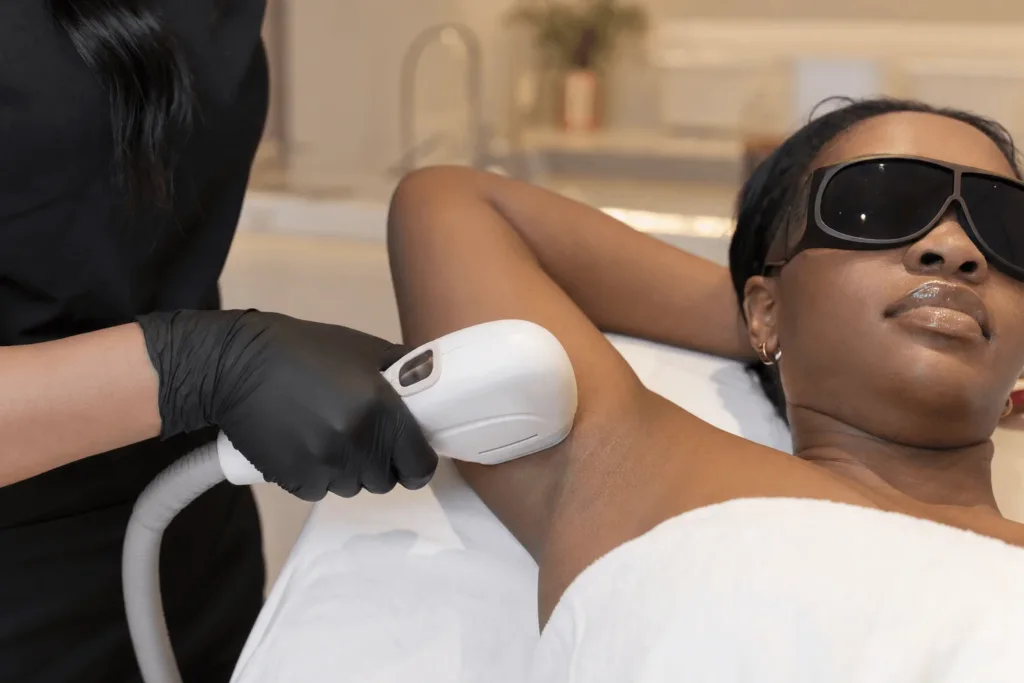
Laser hair removal for dark skin requires specialized technology and expertise to deliver safe, effective results without causing hyperpigmentation or burns. If you have darker skin tones (Fitzpatrick types IV through VI), you need a provider who understands how melanin-rich skin responds to laser energy and uses equipment specifically designed to bypass surface pigment while targeting hair follicles.
This guide covers everything you need to know about safe laser hair removal on darker skin: the technology that made it possible, how to assess your candidacy, what safety protocols prevent post-inflammatory hyperpigmentation, and how to choose an experienced Montreal provider who follows Quebec’s certification standards for diverse skin types.
At Arezoo Beaute in Montreal, our team has over nine years of experience serving clients across all skin tones, combining proper technology selection with individualized treatment planning to achieve lasting hair reduction while protecting skin integrity.
Quick Answer
Laser hair removal is safe for dark skin when performed with Nd:YAG lasers using 1064 nm wavelength technology. This longer wavelength bypasses melanin in the epidermis to target hair follicles directly, preventing burns and hyperpigmentation that older laser types caused on darker skin tones.
Why Laser Hair Removal Was Historically Unsafe for Darker Skin Tones
Early laser hair removal technology could not distinguish between melanin in skin and melanin in hair follicles. The lasers absorbed into both equally, creating serious risks for anyone with higher natural pigmentation.
Alexandrite and IPL systems, which dominated the market through the early 2000s, used shorter wavelengths between 694-800 nm. These wavelengths penetrated only shallow depths and were strongly attracted to melanin at the skin’s surface.
For clients with Fitzpatrick skin types IV, V, and VI, this meant laser energy heated the epidermis itself rather than traveling deeper to the hair follicle. The result was thermal injury: burns, blistering, scarring, and severe post-inflammatory hyperpigmentation that could last months or become permanent.
The fundamental problem was physics, not technique. Short-wavelength lasers targeting melanin will always pose unacceptable risk when skin melanin density approaches or exceeds hair melanin density.
Key Takeaways
- Choose Nd:YAG laser technology for safe treatment on darker skin tones
- Verify your provider uses 1064 nm wavelength systems, not IPL or Alexandrite
- Expect 6-8 sessions spaced 6-8 weeks apart for optimal results
- Request test patches and detailed PIH prevention protocols before starting
- Confirm Montreal certification and experience treating Fitzpatrick types IV-VI
How Nd:YAG Laser Technology Changed Everything for Dark Skin
Nd:YAG (neodymium-doped yttrium aluminum garnet) lasers revolutionized laser hair removal for melanin-rich skin by using a fundamentally different wavelength that behaves differently in tissue.
How 1064 nm Wavelength Bypasses Melanin in Skin
The 1064 nm wavelength used by Nd:YAG lasers is significantly longer than older systems. This extended wavelength has lower melanin absorption in the epidermis while maintaining sufficient absorption in the hair follicle’s bulb and bulge.
Think of it like selective depth targeting. The laser energy passes through the melanin-containing surface layers without generating damaging heat there, then concentrates its thermal effect at the deeper follicle level where hair growth originates.
This longer wavelength also penetrates 5-7 mm into tissue, compared to 2-3 mm for shorter wavelengths. That extra depth reach means the laser can effectively target thicker, coarser hair common in clients with darker skin while maintaining safety margins.
Pulse duration also plays a crucial role. Nd:YAG systems use longer pulse widths (typically 10-100 milliseconds) that allow gradual heating of the follicle while giving surrounding tissue time to cool. This thermal selectivity prevents the explosive heating that caused burns with older, shorter-pulse systems.
Why IPL and Alexandrite Lasers Still Pose Risks
Despite advances, IPL systems and Alexandrite lasers (755 nm) remain unsuitable for Fitzpatrick types IV-VI. Their shorter wavelengths still create excessive epidermal heating that cannot be fully mitigated by cooling or reduced energy settings. Even diode lasers (800-810 nm) show higher complication rates on darker skin compared to proper Nd:YAG systems.
At Arezoo Beaute, treatment planning begins with skin type assessment and technology matching. Our approach ensures clients receive appropriate wavelength selection based on their Fitzpatrick classification, not one-size-fits-all protocols designed for lighter skin tones.
Expert Tip from Arezoo Beaute
We always perform test patches on a small treatment area during initial consultations for clients with darker skin tones. This reveals exactly how your skin responds to the specific laser settings we plan to use, confirming safety before proceeding with full treatment areas.
Understanding Your Candidacy: The Fitzpatrick Skin Type Scale
The Fitzpatrick scale classifies skin into six types based on melanin density, sun sensitivity, and burning versus tanning response. Understanding where you fall on this scale determines your candidacy and treatment protocol.
Fitzpatrick Type I: Pale white skin that always burns, never tans. Excellent candidate for all laser types.
Fitzpatrick Type II: Fair skin that usually burns, tans minimally. Excellent candidate for all laser types.
Fitzpatrick Type III: Medium skin that sometimes burns, gradually tans to light brown. Good candidate for most lasers including diode and Nd:YAG.
Fitzpatrick Type IV: Olive or light brown skin that rarely burns, tans easily to moderate brown. Requires Nd:YAG laser for safety.
Fitzpatrick Type V: Brown skin that very rarely burns, tans deeply. Requires Nd:YAG laser with conservative settings.
Fitzpatrick Type VI: Dark brown to black skin that never burns. Requires Nd:YAG laser with individualized protocols.
Most individuals of African, Caribbean, South Asian, Middle Eastern, and Latin American descent fall into types IV through VI. Fitzpatrick classification is not purely visual. A trained provider assesses natural untanned skin color, family history of scarring or hyperpigmentation, and how your skin responds to injury. Hair color relative to skin tone also matters.
Expert Tip from Arezoo Beaute
If you have darker skin and notice any history of dark spots after cuts, burns, or acne, mention this during consultation. It indicates higher PIH susceptibility and may require modified treatment intervals or additional protective protocols beyond standard approaches.
Safety Protocols and Preventing Post-Inflammatory Hyperpigmentation
Post-inflammatory hyperpigmentation (PIH) remains the most common complication of laser hair removal on darker skin, even with proper Nd:YAG technology. PIH appears as darkened patches where laser treatment occurred, triggered by inflammatory response rather than direct thermal injury.
PIH differs from burns. Burns result from excessive immediate heat causing tissue damage. PIH results from the skin’s healing response producing excess melanin in treated areas, even when no burn occurred. Melanin-rich skin has more active melanocytes that respond more aggressively to any inflammatory stimulus.
Montreal Certification Standards for Laser Treatment on Diverse Skin
Quebec requires specific certification for laser hair removal practitioners beyond general aesthetics licensing. The College des Medecins du Quebec oversees laser device operation, and Montreal providers must demonstrate competency in treating diverse skin types, not just lighter tones.
Legitimate Montreal clinics maintain documentation of laser safety training specific to melanin-rich skin, including proper Fitzpatrick assessment, appropriate energy selection formulas for darker types, and PIH prevention protocols. Arezoo Beaute follows Quebec’s comprehensive safety standards with additional protocols developed through nine years of serving Montreal’s diverse clientele.
Sun Protection and Between-Session Care for Melanin-Rich Skin
Sun exposure before or after laser treatment dramatically increases PIH risk for darker skin types. UV exposure activates melanocytes, making them hypersensitive to the inflammatory effects of laser energy.
Strict protocols require four weeks pre-treatment daily SPF 50+ broad-spectrum sunscreen on treatment areas, reapplied every two hours during sun exposure. No tanning, including self-tanner. Between sessions, continue daily SPF 50+ application and avoid direct sun exposure during peak hours. Post-treatment, keep treated areas covered and cool for 48 hours. No hot showers, saunas, or intense exercise for 24-48 hours.
Montreal’s seasonal variation affects treatment planning. Winter months (November through March) offer ideal timing for starting laser hair removal on darker skin because reduced sun exposure naturally lowers PIH risk.
AREZOO BEAUTE
Ready to enhance your natural beauty?
Book your consultation today and let our expert team help you choose the perfect treatment for your goals.
What to Expect During Your Treatment Sessions
Treatment sensation, visible response, and session structure differ meaningfully between darker and lighter skin types. Understanding these differences prevents unrealistic expectations and helps you gauge whether your provider is following appropriate protocols.
Treatment Sensation and Pain Levels: Comparing Skin Tones
During the procedure, you will feel repeated snapping or stinging sensations as the laser pulses. Nd:YAG lasers used for darker skin typically feel more intense than shorter-wavelength systems used on lighter skin because the longer pulse duration creates a prolonged heating sensation rather than a quick snap.
Clients with lighter skin (Fitzpatrick I-III) treated with Alexandrite or diode lasers often describe the sensation as quick rubber band snaps. In contrast, darker-skinned clients (Fitzpatrick IV-VI) receiving Nd:YAG treatment experience a deeper, more sustained warming sensation combined with surface cooling.
Pain tolerance varies individually, but most clients with darker skin report moderate discomfort, especially on sensitive areas like bikini line or facial zones. The sensation is typically more tolerable than traditional Brazilian waxing because it is briefer and does not involve pulling.
Cooling Methods Adjusted for Darker Skin
Darker skin requires more aggressive cooling to prevent surface heat accumulation while the laser targets deeper follicles. Most modern Nd:YAG systems include integrated cooling through cryogen spray, contact cooling tips, or forced air systems.
For darker skin types, cooling adjustments include longer pre-cooling periods (2-3 seconds before each pulse versus 1 second for lighter skin), contact cooling tip temperatures set 5-10 degrees lower, and post-pulse cooling extended to allow complete heat dissipation. This creates a distinct hot-cold alternating sensation that helps manage discomfort while protecting the epidermis.
Providers treating lighter skin often use minimal cooling or rely solely on air cooling. The more intensive cooling required for darker skin is essential for both comfort and safety. If you do not feel distinct cooling between or during pulses, ask your provider why. Inadequate cooling on darker skin increases both discomfort and PIH risk.
| Treatment Area | Session Duration | Typical Discomfort Level (1-10) |
|---|---|---|
| Upper Lip | 5-10 minutes | 4-6 |
| Underarms | 10-15 minutes | 3-5 |
| Bikini Line | 15-20 minutes | 5-7 |
| Brazilian | 20-30 minutes | 6-8 |
| Lower Legs | 30-45 minutes | 3-5 |
| Full Legs | 45-90 minutes | 4-6 |
Immediate Response and Hair Shedding Timeline
Your skin will show immediate response: mild redness, slight swelling around follicles, and possibly small white rings around treated hairs. This is normal inflammatory response. The redness should fade within 2-24 hours for most people. Persistent redness beyond 48 hours may indicate excessive energy levels.
Hair shedding happens gradually over 1-3 weeks post-treatment as the damaged follicle expels them. You may notice hairs appearing to grow during this period before they shed. This is normal and not treatment failure. Between sessions, shaving is permitted and recommended. Never wax, pluck, or thread during a laser hair removal series.
How Hormonal Factors and Hair Texture Affect Treatment Planning
Hormonal conditions significantly impact treatment outcomes for clients with darker skin. Polycystic ovary syndrome (PCOS), thyroid disorders, insulin resistance, and certain medications (including hormonal birth control and corticosteroids) cause excessive hair growth that requires longer treatment series and more frequent maintenance sessions.
Women with PCOS often need 10-12 initial sessions rather than the standard 6-8, plus quarterly or biannual maintenance indefinitely because the condition continuously stimulates new follicle activation. Thyroid imbalances can slow treatment response, requiring sessions spaced closer together (4-6 weeks instead of 6-8 weeks) to catch active growth phases.
Coarse, curly hair common in many darker-skinned individuals responds well to laser treatment because it contains abundant melanin to absorb laser energy. However, this hair texture also tends to have deeper, stronger follicles that may require 8-10 sessions rather than 6-8 for complete reduction. The curly growth pattern means hair cycles are less synchronized, requiring additional sessions to catch all follicles during their growth phase.
Fine or light brown hair may require additional sessions or may not respond as dramatically. During consultation, discuss any hormonal conditions, medications, or family history of excess hair growth so the provider can set appropriate expectations and customize session frequency.
At Arezoo Beaute, we schedule treatment sessions 6-8 weeks apart for most body areas, adjusted based on your hair growth cycles, hormonal factors, and how your specific skin responds.
How to Choose an Experienced Provider in Montreal
Provider selection is the single most important factor determining safety and results for laser hair removal on darker skin. Technology alone is not sufficient without proper expertise in using it on melanin-rich skin types.
Start by confirming laser type. Ask directly: “What specific laser system do you use, and what is the wavelength?” The answer must be Nd:YAG with 1064 nm wavelength. If they mention IPL, Alexandrite, or cannot specify wavelength, eliminate them from consideration.
Request information about the technician’s specific experience treating your Fitzpatrick type. “How many clients with type V skin have you treated?” is more useful than “Do you treat darker skin?” Check reviews and before/after galleries specifically showing results on darker skin tones.
Ask about test patch protocol. Experienced providers always perform test patches on darker skin before committing to full treatment areas. Inquire about PIH prevention protocols specific to your skin type. The provider should discuss sun protection requirements, timeline considerations, and what products or practices to avoid between sessions.
Quebec certification matters. Ask to see documentation of laser safety training and Quebec regulatory compliance. Consultation quality reveals expertise level. During your initial appointment, the provider should perform thorough Fitzpatrick assessment, discuss realistic expectations for your specific combination of skin tone and hair characteristics, explain session number estimates, and outline detailed safety protocols.
Arezoo Beaute offers free consultations that include comprehensive skin assessment, detailed treatment planning for your individual characteristics, and transparent discussion of expected results and timelines.
Benefits and Realistic Results Timeline for Darker Skin Tones
Laser hair removal delivers substantial benefits for darker skin beyond simple hair reduction. Understanding realistic timelines and results prevents disappointment from unrealistic expectations set by marketing materials based on lighter skin types.
The most dramatic improvement many clients with melanin-rich skin notice is elimination of ingrown hairs. Coarse, curly hair common in darker-skinned individuals tends to curl back into skin after shaving or waxing, creating painful ingrown hairs and resulting hyperpigmentation. Laser treatment damages follicles enough to produce finer, straighter regrowth less prone to becoming ingrown.
Reduction of post-shaving or post-waxing hyperpigmentation is another major benefit. The chronic inflammation from repeated hair removal trauma contributes to darkened patches on commonly treated areas like underarms, bikini line, and legs. Eliminating the need for frequent mechanical hair removal allows this hyperpigmentation to gradually fade.
Session requirements typically range from 6-8 treatments for body areas, sometimes extending to 8-10 sessions for areas with hormonal influence like face, chest, or bikini zone. This is 1-2 sessions more than often quoted for lighter skin types because conservative energy settings required for safety mean each session achieves slightly less follicle destruction.
Hair reduction is progressive. After the first session, expect 10-20% permanent reduction. This percentage increases cumulatively with each subsequent treatment. By session four, most clients notice 50-60% reduction. Final results after the complete series typically achieve 80-90% permanent reduction, with occasional fine regrowth requiring maintenance sessions.
| Session Number | Cumulative Hair Reduction | Weeks Since Previous Session |
|---|---|---|
| Session 1 | 10-20% | N/A (first treatment) |
| Session 2 | 25-35% | 6-8 weeks |
| Session 3 | 40-50% | 6-8 weeks |
| Session 4 | 55-65% | 6-8 weeks |
| Session 5 | 65-75% | 6-8 weeks |
| Session 6 | 75-85% | 6-8 weeks |
| Session 7-8 | 80-90% | 6-8 weeks |
Results are permanent for destroyed follicles, but hormonal changes can activate previously dormant follicles over time. This is why some clients opt for annual or biannual maintenance sessions to address new growth, particularly in hormonally sensitive areas.
The complete treatment timeline from first session to final result spans approximately 12-18 months for darker skin types, accounting for the 6-8 week intervals between sessions and the completion of a full series. Starting treatment requires patience and commitment to the full protocol rather than expecting rapid transformation.
Cost considerations matter when planning treatment. While laser hair removal requires upfront investment, it eliminates the ongoing expense of waxing, shaving products, and treatment of ingrown hairs and related hyperpigmentation. For detailed pricing specific to Montreal and different treatment areas, consult a comprehensive pricing guide that breaks down costs by zone and package options.
At Arezoo Beaute, treatment planning includes realistic timeline discussion based on your specific characteristics rather than generic promises. Our approach prioritizes safe, gradual reduction that protects skin integrity over aggressive protocols that increase complication risk.
Frequently Asked Questions
Is laser hair removal safe for dark skin?
Yes, laser hair removal is safe for dark skin when performed with Nd:YAG lasers using 1064 nm wavelength technology. This wavelength bypasses melanin in the epidermis to target hair follicles at deeper levels, preventing burns and hyperpigmentation. Safety depends on using proper technology with conservative energy settings and strict sun protection protocols. Always choose a provider experienced with your Fitzpatrick skin type who performs test patches before full treatment.
What laser is best for dark skin (Fitzpatrick IV-VI)?
Nd:YAG lasers operating at 1064 nm wavelength are the only truly safe option for Fitzpatrick skin types IV through VI. This longer wavelength penetrates deeper while generating less heat in melanin-rich surface skin. Avoid IPL systems, Alexandrite lasers (755 nm), and diode lasers (810 nm) if you have darker skin, as these carry significantly higher risk of burns and hyperpigmentation.
Will laser hair removal cause dark spots or hyperpigmentation on my skin?
Post-inflammatory hyperpigmentation (PIH) is the most common risk for darker skin types, even with proper Nd:YAG technology. However, this risk is manageable through strict protocols: comprehensive sun protection for four weeks before and throughout treatment, appropriate energy settings for your Fitzpatrick type, adequate session spacing (6-8 weeks), and gentle skin care between treatments. Test patches reveal your individual PIH susceptibility before full treatment.
How many sessions will I need if I have darker skin?
Most clients with darker skin require 6-8 sessions for body areas, sometimes extending to 8-10 sessions for hormonally influenced zones like face, chest, or bikini area. This is typically 1-2 sessions more than lighter skin types because conservative energy settings required for safety mean each session achieves slightly less follicle destruction. Sessions are spaced 6-8 weeks apart. The complete timeline spans approximately 12-18 months.
How do I know if my provider is experienced with darker skin tones?
Ask specific questions: What laser system and wavelength do you use? How many clients with my Fitzpatrick type have you treated? Can you show before/after results on skin similar to mine? Do you perform test patches before full treatment? What PIH prevention protocols do you follow? Experienced providers answer confidently with specific details, perform thorough Fitzpatrick assessment, and never rush to treatment without testing response. Quebec certification should be documented and displayed.
Laser hair removal for dark skin has evolved from unsafe and ineffective to reliable and transformative through proper Nd:YAG technology and specialized treatment protocols. Success depends on choosing a Montreal provider with genuine expertise in treating melanin-rich skin types who follows Quebec’s certification standards and prioritizes safety over speed.
Arezoo Beaute combines over nine years of experience serving Montreal’s diverse clientele with the technology, training, and individualized approach required for safe, effective laser hair removal on darker skin tones. Schedule your free consultation to receive comprehensive Fitzpatrick assessment, test patch evaluation, and personalized treatment planning designed specifically for your skin type and hair characteristics.