
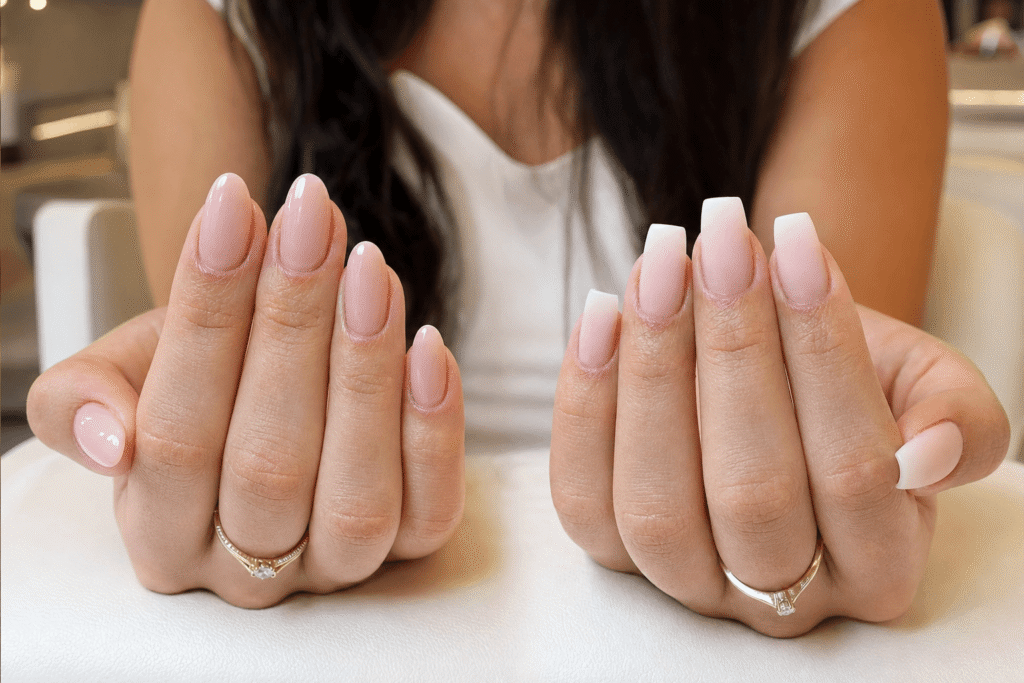
Choosing between gel and acrylic nail extensions involves understanding fundamental differences in composition, application technique, durability, and how each type affects your natural nails. Both options offer beautiful, long-lasting results, but they cater to different needs, lifestyles, and aesthetic preferences.
This guide breaks down the specific characteristics of gel vs acrylic nails, from the molecular structure that defines their flexibility to the removal process that impacts nail health. You’ll learn how each extension type performs in Montreal’s unique climate, what to expect during application, and which option aligns best with your daily activities and maintenance preferences.
Whether you’re considering nail extensions for the first time or contemplating a switch from one type to another, understanding these core differences helps you make an informed decision that balances beauty with practicality.
Quick Answer
Gel nail extensions cure under UV or LED light and offer a flexible, glossy finish, while acrylic extensions use a liquid monomer and powder polymer that air-dry into a hard, durable layer. Gel typically looks more natural and causes less odor during application, whereas acrylic provides stronger reinforcement and withstands heavy wear better.
Key Takeaways
- Understand gel cures with UV light while acrylic air-dries naturally
- Choose gel for flexibility and natural appearance with less odor
- Select acrylic for maximum durability and resistance to heavy use
- Expect gel removal through acetone soaking, acrylic through filing or soaking
- Consider Montreal’s cold climate when selecting your extension maintenance schedule
Understanding Gel and Acrylic Nail Extensions: The Basics
Nail extensions transform short or damaged nails into long, polished canvases that hold color and shape for weeks. The fundamental difference between gel and acrylic nail extensions lies in their chemical composition and how they harden.
Gel extensions consist of oligomers and monomers that form a pliable substance requiring UV or LED light exposure to cure. The curing process triggers a photochemical reaction that solidifies the gel into a smooth, glossy surface. This light-activated hardening distinguishes gel from traditional polish and creates a bond with the natural nail plate.
Acrylic extensions combine liquid monomer (typically ethyl methacrylate or methyl methacrylate) with powder polymer. When mixed, these components create a moldable bead that air-dries through a chemical reaction called polymerization. The technician shapes this mixture over the natural nail or an extension form before it hardens within minutes.
Both systems build length and strength, but their molecular structures create distinct characteristics in flexibility, weight, and appearance.
Composition and Application: How Each Type Works
What Are Gel Nail Extensions?
Gel nail extensions come in several formulations, including hard gel, builder gel, and soft gel. Hard gel and builder gel provide structural strength for extensions, while soft gel typically enhances natural nails or overlays tips.
The application process begins with nail preparation: filing the natural nail surface, pushing back cuticles, and ensuring the nail plate is clean and dry. The technician applies a bonding base coat followed by layers of gel, curing each layer under a UV or LED lamp for 30 to 60 seconds.
Builder gel can be sculpted directly on nail forms to create length, or applied over pre-shaped tips. The gel remains workable until exposed to the specific light wavelength, giving technicians flexibility to perfect the shape before curing. The final result feels lighter than acrylic and has a natural glossy finish that requires minimal buffing.
What Are Acrylic Nail Extensions?
Acrylic nail extensions rely on a two-part system: liquid monomer and powder polymer. The liquid typically contains ethyl methacrylate (EMA), a safer alternative to the older methyl methacrylate (MMA) formula.
Application starts with similar nail preparation: filing, cuticle work, and dehydrating the nail plate. The technician dips a brush into the liquid monomer, then into the powder polymer, creating a bead of acrylic that begins polymerizing immediately upon contact with air.
This bead is applied to the natural nail or over a nail tip or form. The technician has approximately 60 to 90 seconds to shape and smooth the acrylic before it hardens completely. Once hardened, acrylic creates an exceptionally strong surface that resists chips and breaks. After the acrylic sets completely, the technician files and shapes the extension, then applies polish or gel color.
What to Expect During Your First Appointment
Your first nail extension appointment typically lasts 75 to 120 minutes, depending on whether you choose gel or acrylic and the complexity of your desired look. Arriving with clean, polish-free nails helps the technician assess your natural nail condition and discuss realistic expectations.
Before your appointment, avoid cutting your cuticles or aggressive filing, as this can create sensitivity during application. Remove any existing polish completely. If you have concerns about nail health, allergies, or specific durability requirements, prepare to discuss these during your consultation.
The consultation portion addresses your lifestyle, preferred length, shape options (square, round, coffin, almond, stiletto), and any nail health concerns. Be honest about your daily activities, as this guides the technician’s recommendations for extension type and length that will actually work for your life. First-time clients should consider starting with shorter lengths to adjust to the feel and function of extensions before committing to dramatic length.
Nail preparation takes approximately 15 to 20 minutes and involves filing the natural nail surface, pushing back cuticles, removing dead skin, and cleaning the nail plate with a dehydrating solution. This step directly affects how well extensions adhere and how long they last before lifting.
During application, expect to sit relatively still while keeping your hands steady. Gel application involves multiple thin layers with curing time between each coat, while acrylic application moves more quickly as each nail is completed before moving to the next. Some clients find the chemical smell of acrylic overwhelming during their first appointment.
Final steps include cuticle oil application and aftercare instructions. Your technician should explain how to protect your new extensions, when to schedule your first fill (typically 2 to 3 weeks), and what warning signs indicate problems requiring earlier attention.
Post-appointment sensitivity is normal for 24 to 48 hours as your nail beds adjust to the extension weight. Avoid hot water immediately after application, as heat can affect the bonding process. Your hands may feel slightly clumsy initially while you adapt to increased nail length and thickness. Most people adapt within three to five days. Using the pads of your fingers rather than the tips helps during this transition period and prevents unnecessary stress on the extensions.
Expert Tip from Arezoo Beaute
Montreal clients frequently underestimate how winter activities affect nail extensions. If you wear gloves daily, ski regularly, or work outdoors, acrylic typically withstands repeated temperature changes better than gel, which can develop microscopic stress cracks in extreme cold.
Side-by-Side Comparison: Gel vs Acrylic Nail Extensions
| Feature | Gel Nail Extensions | Acrylic Nail Extensions |
|---|---|---|
| Composition | Oligomers and monomers cured with UV/LED light | Liquid monomer and powder polymer that air-dry |
| Application Time | 60 to 90 minutes for full set | 45 to 75 minutes for full set |
| Odor During Application | Minimal to none | Strong chemical smell requiring ventilation |
| Flexibility | More flexible, mimics natural nail movement | Rigid and hard, less natural flex |
| Appearance | Naturally glossy, translucent finish | Opaque, requires polish for shine |
| Weight on Natural Nail | Lighter, less noticeable | Heavier, more substantial feel |
| Durability | Moderate, may chip with heavy impact | Very durable, withstands significant wear |
| Typical Lifespan | 2 to 3 weeks before fill needed | 2 to 4 weeks before fill needed |
| Removal Method | Acetone soak (soft gel) or file off (hard gel) | Acetone soak or file off |
| Removal Time | 15 to 30 minutes (soak-off gel) | 20 to 40 minutes |
| Damage Risk to Natural Nails | Lower when properly applied and removed | Moderate, depends on application and removal technique |
| Best For | Natural appearance, flexible wear, sensitive to odors | Maximum strength, heavy hand use, long-term wear |
The choice between gel and acrylic nail extensions often comes down to personal preference and lifestyle demands. Gel appeals to clients seeking a more natural look with lighter weight, while acrylic suits those prioritizing extreme durability and strength.
AREZOO BEAUTE
Ready to enhance your natural beauty?
Book your consultation today and let our expert team help you choose the perfect treatment for your goals.
Cost Comparison: Initial Investment and Ongoing Maintenance
Understanding the complete cost of nail extensions includes both the initial application and regular maintenance appointments. Prices in Montreal vary based on salon location, technician experience, and product quality.
| Service Type | Gel Extensions | Acrylic Extensions |
|---|---|---|
| Full Set (Initial Application) | $60 to $100 | $45 to $85 |
| Fill/Infill (Every 2-3 Weeks) | $40 to $70 | $35 to $60 |
| Removal Only | $15 to $30 | $15 to $30 |
| Removal with New Set | Often included or $10 to $15 | Often included or $10 to $15 |
| Annual Maintenance Cost (Avg.) | $960 to $1,680 | $840 to $1,440 |
Gel nail extensions typically cost more upfront due to specialized equipment and premium product formulations. Acrylic extensions offer a more budget-friendly option, particularly for clients maintaining extensions year-round. Hidden costs include nail repair appointments if an extension breaks or lifts prematurely.
Durability, Maintenance, and Removal: What to Expect Long-Term
How Long Each Type Lasts and Maintenance Requirements
Gel nail extensions typically maintain their appearance for 2 to 3 weeks before requiring a fill appointment. As your natural nail grows, a gap appears at the cuticle line, and the extension may begin lifting at the edges if proper aftercare isn’t followed.
Acrylic extensions last 2 to 4 weeks between fills, with some clients stretching to 5 weeks depending on natural nail growth rate. The rigid structure resists chips and maintains its shape longer under stress.
Both types require regular maintenance appointments called infills or fills. During these sessions, the technician files down the grown-out area, removes any lifting, and applies new product to blend the extension seamlessly with your natural nail growth. Daily maintenance includes keeping extensions dry for extended periods, avoiding harsh chemicals without gloves, and moisturizing cuticles regularly.
Safe Removal Process for Gel and Acrylic Extensions
Proper removal protects your natural nail health and prevents damage that can take months to repair. Never peel or force off nail extensions, as this removes layers of your natural nail plate and causes weakness, splitting, and pain.
Soak-off gel removal involves saturating cotton pads with acetone, placing them on each nail, and wrapping with foil or using nail clips. After 15 to 20 minutes, the gel softens enough to gently scrape away with a wooden cuticle stick. Hard gel cannot be soaked off and must be carefully filed away by a trained technician.
Acrylic removal follows a similar acetone soak method but typically requires 20 to 30 minutes due to the denser molecular structure. The acrylic breaks down into a soft, paste-like consistency that slides off the nail surface. Rushing this process by prying off partially dissolved acrylic causes significant damage.
Professional removal is always recommended over at-home attempts. Technicians have proper ventilation, high-quality acetone, and the experience to recognize when product has sufficiently broken down. After removal, your natural nails need recovery time. They may appear thin, feel weak, or show surface irregularities. A break of at least two weeks between extension applications allows the nail plate to restore its natural moisture balance and strength. During recovery, apply cuticle oil daily and use a nail strengthening treatment to support regeneration.
Expert Tip from Arezoo Beaute
We often see clients who’ve damaged their natural nails by picking at lifted extensions. If you notice any separation from the nail bed, book a repair appointment immediately rather than waiting for your scheduled fill. Early intervention prevents moisture infiltration and potential infection, protecting both your extensions and natural nail health.
Natural Nail Health and Safety Considerations
Both gel and acrylic nail extensions can be worn safely when applied correctly and removed professionally. However, improper technique, poor-quality products, or neglecting maintenance creates risks to your natural nail health.
The most common issue with nail extensions is over-filing during preparation or removal. Aggressive filing thins the natural nail plate, removing protective layers and exposing sensitive tissue underneath. This creates weakness, flexibility, and increased susceptibility to infection.
Gel extensions generally cause less immediate damage because they cure with light rather than chemical heat. However, the UV or LED lamp exposure raises concerns about skin damage. Modern LED lamps significantly reduce exposure time compared to older UV lamps, and applying broad-spectrum sunscreen to hands before curing provides additional protection.
Acrylic’s chemical composition can trigger allergic reactions in some individuals, particularly with methyl methacrylate (MMA) formulas. Reputable salons use only EMA-based products, which have significantly lower allergy rates. If you experience redness, swelling, or separation of the nail from the nail bed, remove extensions immediately and consult a healthcare provider.
Lifting between the extension and natural nail creates a pocket where moisture accumulates. This environment promotes bacterial and fungal growth, leading to green nail syndrome (pseudomonas bacterial infection) or fungal infections. Both appear as discoloration and require medical treatment, not just removal of the extension.
Proper sanitation practices in the salon protect against infection transmission. Technicians should use sterilized metal tools, dispose of single-use items like files and buffers, and never double-dip brushes into product containers. At Arezoo Beaute, maintaining strict hygiene protocols across all beauty services ensures client safety and optimal outcomes.
Taking breaks between extension applications allows your natural nails to breathe and recover. During these breaks, focus on nail strengthening treatments, cuticle oil application, and protecting nails from harsh chemicals.
Which Extension Type Is Right for Your Lifestyle?
Montreal’s distinct seasons create unique challenges for nail extensions. Winter brings frigid temperatures that make nails more brittle, while summer humidity can affect product adhesion and curing times.
For clients who spend significant time outdoors during winter, acrylic extensions provide superior resistance to cold-related stress. The rigid structure doesn’t contract and expand as dramatically with temperature changes, reducing crack risk. However, gel’s flexibility can be advantageous for those who frequently transition between heated indoor spaces and cold outdoor environments.
Office workers who type extensively often prefer gel extensions for their lighter weight and natural flexibility. The softer surface feels more comfortable during repetitive finger movements and produces less clicking noise on keyboards.
How Extensions Interact with Daily Activities
Healthcare workers face strict sanitation requirements that impact nail extension choices. Many hospitals prohibit artificial nails entirely due to infection control policies, as extensions can harbor bacteria even with proper hand hygiene. If your workplace permits extensions, choose shorter lengths in either gel or acrylic, maintain impeccable hand washing technique with special attention to cleaning under nails, and use alcohol-based sanitizer frequently. Always verify workplace regulations before investing in extensions.
Parents caring for young children often choose shorter acrylic extensions for their durability during diaper changes, bathing, and constant hand washing. The strength prevents breakage during daily childcare tasks, though extra attention to cleaning under extensions prevents germ accumulation. Shorter lengths also prevent accidental scratching of delicate baby skin during feeding and dressing.
Active gym-goers face specific challenges with nail extensions. Weight lifting can stress the nail bed and cause extensions to lift or crack. Acrylic generally withstands the impact better, though proper glove use during heavy lifting protects both types. The rigid structure of acrylic also prevents flexing that can weaken the bond between extension and natural nail during repetitive gripping exercises.
Swimmers should expect gel extensions to have shorter lifespans due to chlorinated pool water weakening the bond between gel and natural nail. For frequent swimmers, acrylic with proper sealing provides better water resistance, though both types require more frequent maintenance appointments. Apply cuticle oil immediately after swimming to restore moisture and strengthen the seal around extension edges.
Frequently Asked Questions
What is the main difference between gel and acrylic nail extensions?
The primary difference lies in composition and curing method. Gel extensions use light-activated oligomers that cure under UV or LED lamps, creating a flexible, glossy finish. Acrylic extensions combine liquid monomer with powder polymer that air-dries through chemical reaction, forming a harder, more rigid surface. Gel appears more natural and produces minimal odor, while acrylic offers superior durability and strength for heavy use.
Which lasts longer: gel or acrylic nail extensions?
Acrylic nail extensions typically last longer between maintenance appointments, often 2 to 4 weeks compared to gel’s 2 to 3 weeks. Acrylic’s rigid structure resists chips and maintains shape under stress better than gel’s flexible composition. However, actual longevity depends on natural nail growth rate, lifestyle activities, and proper application technique.
Are gel extensions healthier for natural nails than acrylics?
Neither option is inherently healthier when properly applied and removed. Gel extensions generally cause less immediate stress because they cure with light rather than generating chemical heat. However, improper removal of either type damages natural nails significantly. The key factors affecting nail health are technician skill, proper preparation, avoiding over-filing, and professional removal.
How much do gel extensions cost compared to acrylic nails in Montreal?
In Montreal, gel nail extensions typically cost $60 to $100 for a full set with fills ranging from $40 to $70. Acrylic extensions run $45 to $85 for initial application and $35 to $60 for fills. Annual maintenance averages $960 to $1,680 for gel versus $840 to $1,440 for acrylic. Prices vary based on salon location and technician experience.
Can I switch from acrylic to gel nail extensions without damaging my nails?
Yes, you can switch between acrylic and gel extensions with proper removal of existing extensions. Have your acrylic extensions professionally removed through acetone soaking or careful filing, never by peeling or forcing them off. Allow your natural nails at least a few days to recover before applying gel extensions, though a two-week break is ideal for natural nail health.
Choosing between gel and acrylic nail extensions depends on your personal priorities, lifestyle demands, and aesthetic preferences. Both options deliver beautiful, long-lasting results when applied by skilled technicians using quality products.
Gel extensions excel in natural appearance, flexibility, and lighter weight, making them ideal for clients seeking a polished look without rigid feel. Acrylic extensions provide maximum durability and strength, perfect for those with active lifestyles or heavy hand use. Montreal’s seasonal climate considerations, your daily activities, and maintenance commitment all factor into selecting the right extension type for your needs.
At Arezoo Beaute, our experienced team understands how beauty treatments integrate into Montreal lifestyles. While we specialize in permanent makeup, laser hair removal, and PHI-certified aesthetic services, we’re committed to helping clients make informed decisions about all their beauty choices. Ready to explore comprehensive beauty services that complement your personal style? Book your consultation and discover how our expert team can enhance your natural beauty with treatments tailored to your unique goals.